How to Safely Buy Verified Social Media Accounts from Trusted Marketplaces and Sellers
A social media account with two years of consistent posting history, a defined audience, and a clean platform record is worth real money - and the market that has formed around buying and selling these accounts reflects exactly that. What began as informal trades on niche forums has matured into a structured commercial ecosystem, complete with dedicated platforms, seller rating systems, and escrow-based payments. The opportunity is genuine: acquiring an established account can compress months of organic growth into a single transaction. But the risks are just as real. Scams are common, platform policies create ongoing exposure, and buyers who skip due diligence often find themselves with an account that disappears within a week of purchase.
The difference between a successful purchase and a costly mistake almost always comes down to where you buy and how you evaluate what's being sold. Researching the best websites to buy accounts at https://accsmarket.com/ gives you a concrete reference point for what a legitimate, structured marketplace actually looks like - including the verification standards, seller accountability systems, and transaction protections that separate professional platforms from ad-hoc sellers operating without any oversight.
This guide covers everything a buyer needs to approach this market confidently: how the account ecosystem works, what verification actually means, how to choose a trustworthy seller, how to execute a secure transaction, and what warning signs should stop you cold. By the end, you'll have a practical framework for making informed decisions whenever you choose to buy social media accounts.
Understanding the Market for Social Media Accounts
Social media accounts accrue value the same way rental properties do - through age, consistent upkeep, and an established track record. An account that has been posting regularly for two years, has never triggered a spam flag, and has grown an engaged audience carries algorithmic credibility that a brand-new account simply cannot replicate overnight. Buyers are not paying for followers alone; they are paying for time, platform trust, and the compound interest of a clean history.
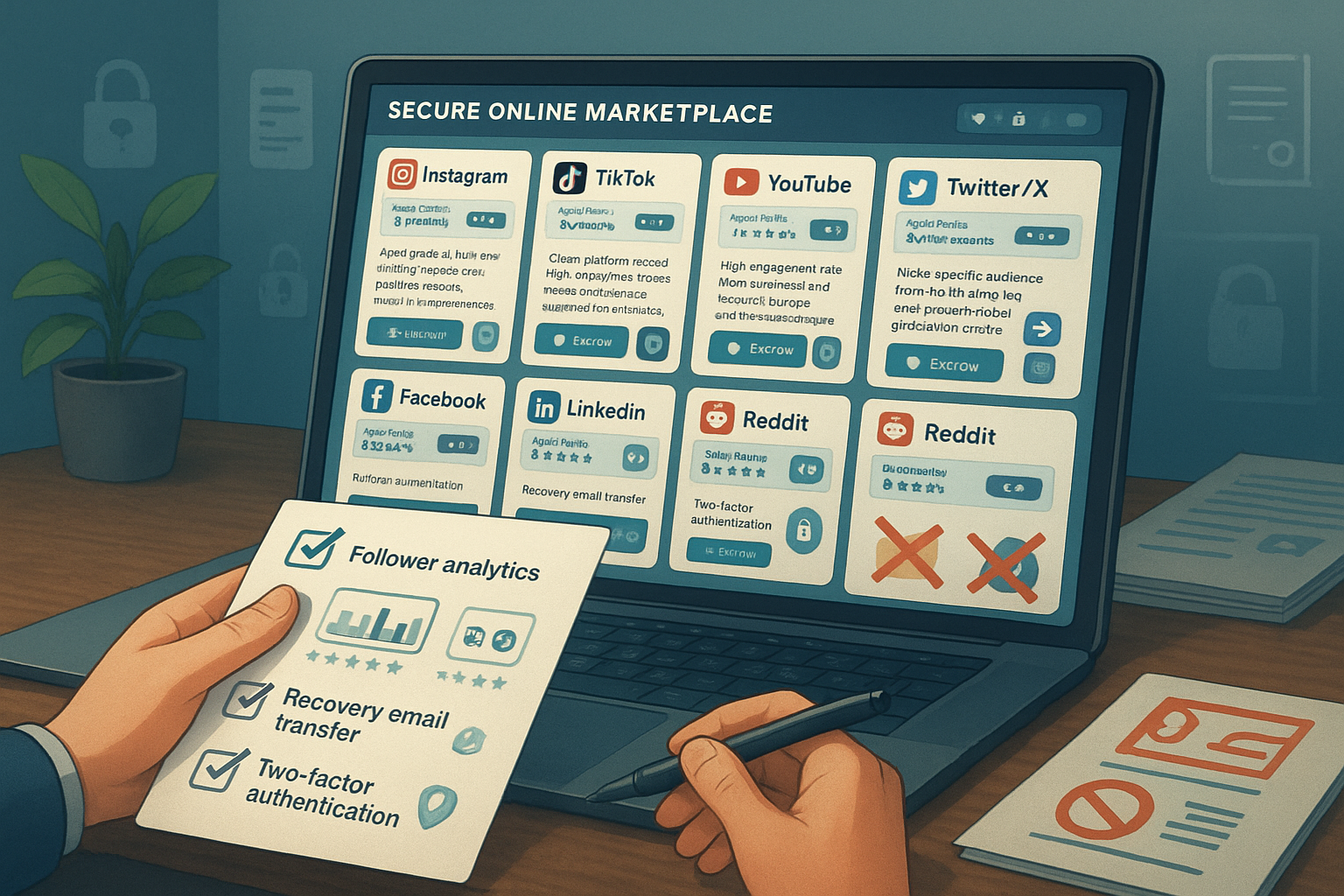
The accounts available across this market span every major platform. Instagram, TikTok, YouTube, Twitter/X, Facebook, LinkedIn, and Reddit all have active secondary markets, each with distinct pricing logic and risk profiles. Within each platform, listings are further differentiated by follower count, engagement rate, niche, monetization status, and the geographic makeup of the audience. A fitness account with 50,000 highly engaged followers in North America is a fundamentally different asset from a general-interest account with the same follower count spread across dozens of countries.
Understanding these distinctions matters because buyers who enter the market without clarity on what they actually need tend to make purchases they later regret. Common account types available include:
- Aged accounts with multi-year posting histories and documented engagement patterns
- Monetization-enabled accounts, such as those meeting YouTube Partner Program thresholds or TikTok Creator Fund eligibility requirements
- Niche-specific accounts with a clearly defined and targeted follower base
- Platform-verified accounts carrying official badges or checkmarks
- Bulk accounts intended for advertising campaigns or audience growth testing
It is also worth being direct about the legal gray area that defines this market. Buying and selling social media accounts typically violates the terms of service of the platforms involved. This does not make the activity illegal in most jurisdictions, but it does mean that platform enforcement - not legal liability - is the primary risk buyers carry. Acknowledging this upfront is not a reason to avoid the market entirely; it is a reason to enter it with eyes open and risk managed deliberately.
What "Verified" Actually Means When You Buy Social Media Accounts
The word "verified" appears constantly in account listings, and sellers use it to mean at least two entirely different things. Conflating them is one of the most common and expensive misunderstandings in this market. Every buyer needs to understand both meanings before evaluating a single listing.
Platform Verification vs. Seller Verification
Platform verification refers to the official badge or checkmark granted by the social media platform itself. Meta's verified badge, the blue checkmark on Twitter/X, and YouTube's verification tick all fall into this category. These marks signal that the platform has confirmed the account's identity, authenticity, or prominence. Accounts carrying these badges command higher prices, attract more credibility from their audiences, and are genuinely more valuable as assets - though they also attract more scrutiny when ownership changes hands.
Seller verification is an entirely separate concept. It refers to the due diligence process a marketplace or individual seller applies to confirm that a listed account is legitimate before offering it for sale. A seller claiming an account is "verified" in this sense should mean that the credentials are active and functional, the account is in good standing with no pending restrictions, the follower data reflects real activity, and the transfer process has been completed before - or can be executed cleanly. This is what the phrase "trusted online accounts" actually means in the context of reputable marketplaces: accounts that have passed a structured review, not simply accounts that carry a platform badge.
What Makes an Account Genuinely Verified by a Seller
When a credible verified account seller lists an account, genuine verification involves specific, demonstrable steps - not just a checkbox on a listing form. Buyers should expect and demand evidence of the following before committing to any purchase:
- Confirmation that the account is not currently under a ban, shadow restriction, or active platform review
- Authentication of follower quality - real, human followers versus bot-inflated counts
- Documentation of account age and a consistent posting history
- Confirmation that the recovery email and phone number associated with the account can be fully transferred to the buyer
- Screenshot or video evidence of current account analytics, including follower growth trends and engagement data
- A stated policy on replacement or refund if the account becomes inaccessible within a defined window after purchase
Any seller unwilling to provide this evidence before payment should be treated as a red flag, regardless of how polished their listing appears.
How to Identify Top Account Marketplaces and Trusted Sellers
Choosing where to buy is the single most consequential decision in the entire purchasing process. The platform or seller you select determines the quality of the account you receive, the security of the transaction, and whether you have any meaningful recourse if something goes wrong. No amount of post-purchase caution can compensate for starting in the wrong place.
Characteristics of Reputable Marketplaces
Top account marketplaces share a consistent set of structural features that clearly distinguish them from informal selling environments. These are not superficial qualities - they represent the infrastructure that makes safe account purchasing possible. When evaluating any marketplace, check for:
- Escrow-based payment systems that hold funds until the buyer confirms successful delivery
- Transparent seller profiles with verifiable ratings and detailed review histories
- A formal dispute resolution process managed by the platform, not left to the buyer and seller to resolve privately
- Clear listing standards requiring sellers to submit account evidence before listings go live
- Anti-fraud measures including identity verification or vetting requirements for sellers
- Active customer support accessible before and after a transaction is completed
The contrast with forum-based or Telegram-based sales is stark. In those environments, sellers operate without accountability structures of any kind. If an account stops working after payment, the buyer has no escalation path and typically no way to recover funds. Reputable platforms exist precisely to eliminate that dynamic.
How to Evaluate Individual Sellers
Even within a reputable marketplace, individual sellers vary considerably in quality and reliability. A structured evaluation process before committing to a purchase is not overcaution - it is standard practice among experienced buyers. Follow this sequence:
- Review the seller's total completed transactions and the ratio of positive to negative feedback across all of them, not just the most recent few.
- Read recent reviews carefully for specific mentions of account validity issues, failed transfers, or communication problems.
- Contact the seller directly and request live proof of account access - a screen recording showing the current dashboard, follower analytics, and account status.
- Ask explicitly what happens if the account becomes inaccessible within 24 to 72 hours of purchase, and get the answer in writing through the platform's messaging system.
- Confirm that the seller is willing to conduct all communication through the marketplace's built-in tools rather than moving to an external app before the transaction is complete.
A seller who insists on moving to Telegram, WhatsApp, or direct email before completing a transaction is signaling that they want to operate outside the marketplace's accountability system. That is a clear reason to walk away.
Marketplace Comparison: What to Look For
Before selecting a platform, comparing options across consistent criteria helps clarify which marketplace best fits your needs and offers the most protection. The following framework covers the factors that matter most:
| Evaluation Criteria | What to Check | Why It Matters |
|---|---|---|
| Payment Protection | Whether escrow or a secure checkout is available | Prevents financial loss if the account is invalid or not delivered as described |
| Seller Vetting | Whether sellers are identity-verified or subject to review before listing | Filters out anonymous bad actors with no accountability |
| Listing Quality Standards | Whether sellers are required to submit account evidence before a listing is approved | Reduces the volume of fraudulent or misrepresented listings |
| Dispute Resolution | Whether a formal, platform-managed complaint process exists | Gives buyers a structured path to recourse when something goes wrong |
| Platform Coverage | Which social media platforms are supported by the marketplace's listings | Ensures you can find accounts for the specific platform you need |
| Review Authenticity | Whether reviews are verifiable, tied to real transactions, and specific in content | Indicates genuine transaction history rather than fabricated reputation |
Step-by-Step Guide to Safe Account Purchasing
Knowing where to buy is necessary but not sufficient. Safe account purchasing requires a deliberate process from initial research through post-purchase security. Each step in the sequence below addresses a specific category of risk. Skipping steps does not save time - it transfers risk onto the buyer.
Before You Buy: Research and Preparation
Most purchasing mistakes are made before any money changes hands. Buyers who enter the market without a clear picture of what they need and what it should cost are easy targets for overpriced listings and fraudulent sellers. Preparation removes the guesswork:
- Define your requirements precisely: platform, content niche, minimum follower count, acceptable engagement rate, preferred geographic audience, and any monetization requirements.
- Set a realistic budget by reviewing multiple listings across at least two different platforms. Understand the market rate before approaching any seller.
- Identify two or three reputable marketplaces and compare listings across all of them before narrowing your focus to a single seller.
- Build a verification checklist - the specific evidence you will require from any seller before authorizing payment.
- Prepare a fresh email address to associate with the account immediately after purchase, so you are ready to act quickly once access is granted.
During the Purchase: Transaction Safety
The transaction window is where financial exposure is highest. The habits that protect buyers in this phase are straightforward and non-negotiable:
- Never pay through irreversible methods - such as direct cryptocurrency transfers to unknown parties - without the protection of an escrow system.
- Use the marketplace's built-in payment infrastructure. Agreeing to pay outside the platform's system removes every layer of protection the marketplace provides.
- Request a live screen recording or video call showing the account's current status, login access, and analytics dashboard before confirming any payment.
- Do not release escrow funds until you have personally logged in, confirmed the account matches the listing description, and begun the process of securing the credentials.
After the Purchase: Securing Your New Account
Once you have access, speed is critical. Every minute that the previous owner retains any recovery pathway to the account is a minute of exposure. Execute the following steps in order:
- Change the account password immediately upon first login.
- Update the recovery email address and phone number to your own verified contact information.
- Enable two-factor authentication using your own authenticator app or phone number.
- Review all third-party applications connected to the account and revoke access for any you do not recognize or intend to use.
- Avoid dramatic changes to posting frequency, content style, or login location in the first several days. Abrupt behavioral shifts can trigger automated platform review processes.
Red Flags and Scams to Avoid
The social media account market attracts a disproportionate number of bad actors because the product is intangible, delivery is immediate, and inexperienced buyers often lack the benchmarks to recognize a fraudulent listing until it is too late. Understanding the specific tactics scammers use is one of the most practical things a buyer can do.
Common Scam Tactics
The most frequently reported scams in this space follow recognizable patterns. Familiarity with these patterns allows buyers to identify risk before committing funds:
- Fake proof: Sellers provide edited or staged screenshots showing inflated follower counts, fabricated engagement rates, or analytics that do not reflect the actual account being sold.
- Credential switching: After receiving payment, the seller initiates a password reset using the original recovery email - which they retained - and reclaims the account before the buyer can secure it.
- Banned account sales: Accounts already under shadow bans, active restrictions, or pending platform review are sold as clean, with problems surfacing only after the transaction is complete.
- Bait-and-switch listings: The account shown in listing screenshots differs from the account whose credentials are delivered after payment.
- Off-platform payment pressure: Sellers push for direct PayPal, bank transfer, or cryptocurrency payments specifically to bypass the marketplace's escrow and dispute systems.
Red Flags in Listings and Seller Behavior
Beyond specific tactics, certain listing characteristics and seller behaviors are reliable indicators of elevated risk. Treat the following signals seriously:
| Red Flag | What It Suggests |
|---|---|
| Price significantly below comparable listings on the same platform | The account is likely banned, misrepresented, or has a hidden restriction that will surface after purchase |
| Seller profile with no reviews or a very recent creation date | No accountability history; the seller cannot be evaluated based on past performance |
| Refusal to provide live proof of account access before payment | The account may not match the listing, or the seller may not have current access |
| Artificial urgency or pressure to complete the transaction immediately | A tactic to prevent the buyer from conducting due diligence |
| Request to move communication to an external messaging platform before the deal closes | An attempt to operate outside the marketplace's dispute resolution scope |
| Follower-to-engagement ratio that appears inconsistent with the claimed niche | Followers may have been artificially inflated through purchased engagement or bot activity |
Pricing, Negotiation, and What Accounts Should Actually Cost
Entering any market without a working understanding of fair pricing puts buyers at a systematic disadvantage. In the account market, mispricing is one of the primary vectors through which buyers are either scammed or simply overpay. Neither outcome is acceptable when the information needed to price accounts correctly is available to anyone willing to research it.
Account pricing across trusted online accounts listings is driven by a consistent set of factors. Understanding them gives buyers a rational basis for evaluating any listing:
- Engagement rate relative to follower count - a smaller account with high genuine engagement is often worth more than a larger account with low interaction rates
- Account age and clean history, meaning no prior bans, content violations, or spam flags that could affect future algorithmic standing
- Niche specificity, with finance, fitness, technology, and business accounts typically commanding premiums over general-interest content accounts
- Platform and monetization status, as YouTube channels meeting Partner Program thresholds and Instagram accounts eligible for brand partnerships carry higher valuations
- Geographic composition of the audience, with followers concentrated in North America, Western Europe, and Australia generally valued more highly for advertising and sponsorship purposes
A practical rule of thumb: if a listing price seems dramatically lower than comparable listings across multiple platforms, treat that gap as a risk signal rather than an opportunity. Motivated sellers who need to move inventory quickly almost always have a reason for the urgency - and that reason is rarely favorable to the buyer.
Negotiation is a normal part of the market, particularly for bulk purchases or when dealing with private sellers on established marketplaces. The correct approach is to negotiate through the platform's messaging system, agree on a final price, and process the payment through the platform's secure checkout - never to move negotiation off-platform and execute payment through a separate channel. Any seller who frames negotiating off-platform as a cost-saving measure is effectively asking the buyer to waive all purchase protections.
Legal and Platform Policy Considerations
A complete and honest treatment of this topic requires addressing the policy and legal dimensions directly, without minimizing the risks or overstating them. Buyers deserve a clear-eyed assessment rather than reassurance that everything is fine.
Most major social media platforms explicitly prohibit account transfers in their terms of service. This means that if a platform detects a change of ownership - triggered by a new login location, abrupt changes in device or browser fingerprinting, or unusual activity patterns - the account may be flagged for review or suspended. The risk level is not uniform across platforms or account types.
Key considerations every buyer should factor into their decision:
- Violating a platform's terms of service does not typically create legal liability for buyers in most jurisdictions, but it does expose the account to suspension without any right to appeal or refund from the platform itself.
- Accounts that are managed carefully after purchase - with gradual content transitions, consistent login behavior, and no abrupt changes to posting patterns - face meaningfully lower detection risk than accounts that are immediately overhauled.
- Monetization accounts, particularly YouTube channels in the Partner Program, face heightened scrutiny if platform systems detect an ownership shift, because monetization eligibility is tied to the account holder's identity.
- LinkedIn enforces real-identity policies more strictly than most other platforms, making account transfers on that network riskier than on Instagram or TikTok.
None of this means the market is inaccessible or inherently catastrophic for buyers. It means that platform policy risk is a known variable that should be priced into the decision - not discovered after the fact. Buyers who treat account purchases as permanent, guaranteed assets without understanding the platform exposure they carry are setting themselves up for disappointment.
Questions and Answers
How do I confirm that the followers on an account I'm considering are real before I buy?
Ask the seller for a screen recording taken from inside the account's analytics dashboard, showing follower growth over time, audience demographics, and reach data. Gradual, consistent growth indicates organic development; sudden spikes often reflect purchased followers or bot activity. Public analytics tools can also provide independent engagement data for accounts that have public profiles, giving you a second source to cross-reference against what the seller shows you.
What is the fastest way a seller can reclaim an account after selling it?
The most common method is using the original recovery email to initiate a password reset. If the seller retains access to the email address linked to the account at the time of sale, they can lock the buyer out within minutes. This is why updating the recovery email and phone number to your own contact information - immediately after first login - is the single most time-sensitive step in the post-purchase process.
Is it safe to buy a monetization-enabled YouTube account?
It is possible but carries higher risk than purchasing a standard content account. YouTube's Partner Program ties monetization eligibility to the account holder's identity and compliance history. An ownership change can trigger a review, and if the platform determines the account has been transferred, monetization access may be suspended. Buyers interested in monetization-enabled YouTube accounts should price that policy risk into their decision and avoid paying a premium they cannot afford to lose.
Can I get my money back if the account I bought gets suspended the day after purchase?
Whether you can recover funds depends entirely on where and how you paid. If you used a marketplace with an escrow system and filed a dispute within the platform's defined window - typically 24 to 72 hours after delivery - you have a structured path to a refund or replacement. If you paid directly to a seller outside the marketplace's payment system, recovery is unlikely regardless of the circumstances. This is the most concrete reason to never bypass the marketplace's checkout process, even when a seller offers a discount for direct payment.
How long should I wait before making significant changes to a purchased account?
There is no universal answer, but most experienced buyers in this market recommend a gradual transition period of at least one to two weeks before making noticeable changes to content style, posting frequency, or audience targeting. Abrupt shifts in behavior are more likely to trigger automated platform review systems than slow, incremental changes that mirror how an account naturally evolves over time.
What is the safest type of account to purchase as a first-time buyer?
For first-time buyers, a mid-sized account on a platform with relatively flexible transfer detection - such as Instagram or TikTok - in a niche you understand and can sustain content for represents the lowest-risk entry point. Avoid monetization-dependent accounts, platform-verified accounts with high public profiles, and accounts that require immediate heavy use. Starting with a smaller, more manageable purchase lets you learn the process before committing significant resources.